Toru Okada
The Wind-Up Bird ChronicleToru Okada is the novel’s first-person narrator and its unsettled center: an efficient former law-firm assistant who leaves a stable job without a new plan, then finds himself trying to understand the disappearance of his wife, Kumiko Okada. His search takes him from household routines and odd encounters into dreams, historical testimony, and the dark enclosure of a dry well. The nickname May Kasahara gives him, Mr. Wind-Up Bird, makes his uncertain role vivid: he may be listening for the sound that winds the world’s spring, but he cannot yet see what mechanism his actions set in motion.
Identity and the decision to leave
At thirty, Toru has spent years at a small law firm doing practical work that suits his abilities. He describes himself as quick to learn, efficient, realistic, and good at carrying out the firm’s everyday tasks. The senior partner even offers him a small raise when he announces that he wants to quit. Toru refuses, not because he has a specific alternative in view, but because he is certain he does not want to become a lawyer and fears that remaining at the firm would make the temporary choice permanent. His departure is a decision to stop continuing along a path, rather than a confident step toward another one.
When he tells Kumiko over dinner that he is considering leaving the job, her only response is, “I see.” He cannot tell what she means, and the exchange offers no clear approval or objection. The resignation thus enters the marriage as an unresolved fact: Toru has changed the shape of his days, but neither he nor Kumiko gives that change a settled interpretation.
A name, a voice, and the unfinished story
During a telephone encounter, a woman gives him explicit instructions and speaks as if he were participating in her sexual experience. Toru ends the call without replying, then lies on the sofa and sighs; the conversation has lasted nearly six minutes. When the phone rings again ten minutes later, he leaves it unanswered. After it rings fifteen times and falls silent, the room seems to him to settle into a cold quiet. The episode establishes a pattern in which intimate contact arrives through a disembodied voice, while Toru’s response is withdrawal rather than explanation.
In a conversation with May Kasahara, Toru tells her his name. She repeats it and says it is not much of a name; he answers that it sounds to him like that of a prewar foreign minister. Asked for a nickname, he invents the bird that winds the world’s spring and cries from a tree near his home, although nobody has seen it. May decides he will be Mr. Wind-Up Bird. The nickname is her choice, but it gathers Toru’s own image into a phrase: an unseen bird performs a necessary task, while the world’s workings remain obscure.
When Creta Kano begins telling him the story of her life, she abruptly prepares to leave, apologizing for having taken so much of his time. Toru is flustered; he does not want her to stop in the middle and tells her he is free all afternoon. Creta replies that what she has told him is only an introduction. He brings orange juice from the kitchen, moving deliberately, and finds her still standing in the same place when he returns. She then sits down again. Toru’s insistence makes him a listener to a testimony he cannot yet place, and the interrupted, unfinished account becomes one of several strands that resist immediate understanding.
Loss, waiting, and the search for causes
After swimming at the ward pool, Toru returns home, makes coffee, and tries to arrange Creta’s strange story in chronological order. His thoughts slow; he falls asleep on the sofa and dreams first of Malta Kano, whom he sees in a crowded hall. She is alone at a bar in a conspicuous feathered Tyrolean hat. Toru tries to reach her through the crowd, but when he arrives she has disappeared, leaving her tropical drink before an empty stool. The dream turns the effort to approach another person into an image of arrival after the person is gone.
Later, a registered letter announces the death of Mr. Honda, the fortune-teller Toru and Kumiko had once visited. It is written on heavy rice paper, in brush lettering, and is sent by Tokutaro Mamiya, a former wartime comrade of Corporal Oishi Honda. Toru learns that Mr. Honda died of a heart attack at home, alone; his maid found him slumped over the low table of his foot warmer. The doctors believed he died quickly and suffered little. Acting on Mr. Honda’s detailed instructions and in the absence of surviving relatives, Mamiya is distributing his keepsakes, one of which the dead man wished Toru to receive. The letter brings a past encounter back into Toru’s present through an object not yet delivered, and introduces Mamiya as the intermediary who will carry Mr. Honda’s final wishes.
Toru’s sense of direction remains uncertain. Looking at his face in the bathroom, he thinks that he is thirty, standing still, and unable to find the image he is looking for. At home, the wind-up bird’s call has seemed to accompany a deepening chaos, but the image he needs does not appear. The sequence makes his stagnation more than a question of employment: he cannot yet recognize what his present life is becoming.
When Kumiko fails to come home, Toru waits through the night, reading and listening to music before going to bed with the light on. In the morning, her side of the bed is empty, and her freshly washed summer pajamas lie folded on the night table. He checks the kitchen, living room, Kumiko’s room, bathroom, and closets, finding no trace of her. Their familiar house has not been visibly overturned, yet her absence alters its quiet. He makes coffee, toast, and potato salad alone. In years of marriage, they had almost never missed breakfast together; the meal had been a tacit ritual even when they had missed lunch or dinner. The solitary breakfast makes the disappearance legible through a small domestic custom rather than an explanation.
Toru tells Malta Kano that he thinks his wife has left him and explains that Kumiko did not come home or report to work. Malta tells him that things should become clear in time and that, for now, he must wait. Toru rejects what he hears as smooth generalities: he feels lost, fears something awful is coming, and asks for concrete facts he can see and touch. Their exchange establishes a friction between Malta’s counsel to wait and Toru’s demand for evidence. He is not content to treat uncertainty as a lesson in patience, even as the facts he wants remain unavailable.
The well and the broken marriage
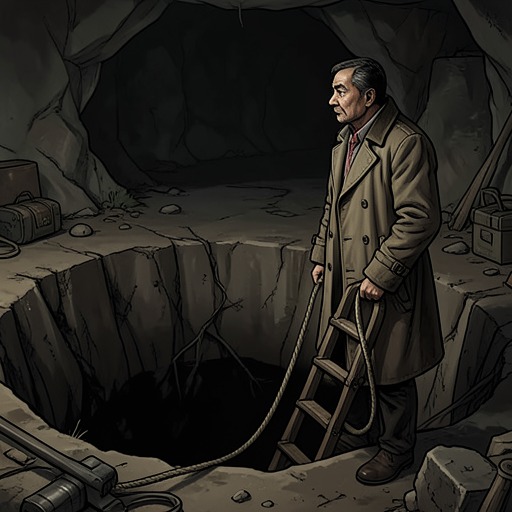
Toru descends into the well seeking solitude and concentration, not simply a hiding place from the news about Kumiko. At its bottom he tests the ground with his shoe, checks that there is no water, and uses a flashlight to examine the dry earth, scattered rocks, and an old potato-chip bag. The smooth concrete wall rises toward a small half-moon of light. A rope ladder remains secured above him, and Toru worries about stale air and poisonous gas before sitting with his back against the wall and letting his body adjust. He names his situation to himself plainly: he is at the bottom of a well. The descent gives physical form to his wish to think, while making that private space dependent on a narrow opening and a ladder back to the surface.
In speaking with May, Toru says that his purpose in the well is to work out where his relationship with Kumiko went wrong. He had not believed their marriage was perfect; he had assumed that the ordinary problems of two people with distinct personalities would resolve themselves over time. Now he thinks he missed something basic. He remembers that, when they married six years earlier, they imagined building a new world together, as if putting a modest house on an empty lot: they wanted shelter and the fact of being together, not elaborate additions. The image sharpens the contrast between the simple world they meant to make and the separation he cannot explain. The well is therefore not only a refuge from events; it is where Toru tries to examine the assumptions on which his marriage rested.
His face-to-face confrontation with Noboru Wataya shows both his resolve and the limits of his knowledge. Toru tells Noboru that Kumiko knows the secret beneath his smooth public mask, and warns that he could expose it. He insists that Noboru cannot reduce him to garbage and rocks: he is a living person who will hit back if struck. Yet Toru admits that the threat is nearly all bluff. He has no concrete knowledge of Noboru’s secret, though he suspects something deeply warped within him. Noboru’s face turns patchily red, and he remains silent instead of responding with the practiced scorn Toru expects. The confrontation produces a visible reaction without confirming what Toru claims to know; his defiance is real, but the knowledge on which he performs it is not.
Refusal, persistence, and narrative role
Ushikawa offers Toru a route back to Kumiko through Noboru Wataya. Toru refuses. He says he intends to get Kumiko back himself and cannot accept Noboru’s existence; he will make no deal with him. He also orders Ushikawa not to enter his house again without permission, explicitly claiming the home as his rather than a public waiting room. The refusal turns Toru’s search into a matter of principle as well as longing: he will not let the person he opposes dictate the terms on which he seeks his wife.
Toru does not, however, mistake refusal for a solution. After Ushikawa’s visit, he watches to see how events develop, asking what about his activities has disturbed Noboru and what countermeasures might follow. He hopes that understanding the pressure on Noboru will bring him closer to the hidden truth and, through it, closer to Kumiko. This patient surveillance contrasts with his earlier demand for immediate, touchable facts. He has not abandoned that demand so much as begun to pursue it by watching for consequences.
The conversations Toru conducts with Kumiko through Cinnamon’s computer give the search a new form. He challenges the metaphor she has used of having gone bad or having an incurable disease: he cannot understand why she went to Noboru rather than staying with him, and asks why they are not together if marriage was meant to join them. Kumiko answers that she is where she has to be and has no right to choose otherwise, even if she wants to see him. Toru then states what he does know: he wants to find the Kumiko who wants him to rescue her. He cannot say how he will reach her or what awaits him there, but after living in what felt like absolute darkness, he believes he is approaching the core of things and intends to continue. His certainty is therefore limited but consequential: he does not possess a route or a complete account of Kumiko’s situation, yet he refuses to treat her absence as the end of their relation.
Toru’s character is made of practical competence set against interpretive uncertainty. He can organize tasks, insist on finishing a story, refuse a bargain, and hold to a search; he cannot always distinguish insight from conjecture, as his bluff against Noboru makes plain. The novel’s first-person form keeps that disparity in view: events reach the reader through a narrator who acts decisively at some thresholds and admits, at others, that he does not know. The bird, the empty bed, the unwelcome silence, and the well recur not as settled answers but as images around which his efforts to understand gather. Mr. Wind-Up Bird names a possible function, not a victory: Toru keeps listening and moving toward the hidden mechanism, while the world’s spring remains difficult to see.